
Denmark is outwardly small. But its cities, policy framework and climate make it a strong candidate for building-integrated photovoltaics (BIPV). The recent study on BIPV thermal trade-offs gives us a chance to stop treating façades and roofs as afterthoughts and to think of buildings as productive infrastructure. Let’s unpack what matters for Danish practice, and compare the likely performance and practical issues with neighbours also North of 49°N, to understand what to adopt and avoid.
Key takeaways
- In cool, high-latitude climates vertical façades and near-vertical glazing can outperform flat roofs in winter because they capture low-angle and diffuse light.
- BIPV can reduce building heat loss in winter if it’s designed as a true façade element with insulation behind it — but poorly designed BIPV can increase thermal bridging.
- Denmark’s climate and dense urban fabric make façade BIPV an especially attractive option in Copenhagen and Aarhus.
- The Netherlands and northern German cities share similar opportunities; Finland has more severe winter sunlight limits but strong potential on south-facing façades and near-vertical canopies.
- The right policy mix — building codes, subsidies, and design guidance — matters more for uptake than marginal improvements in module efficiency.
Why Denmark is well placed for BIPV
- Urban density: Copenhagen, Aarhus and Odense have many mid-rise buildings with large façade area per inhabitant. Where rooftops are scarce, façades are plentiful.
- Cool climate advantage: PV performs better when cool; Danish temperatures help maintain module efficiency.
- Low solar angles in winter: This works against flat-panel summer-optimised designs, but benefits vertical and façade-integrated systems that collect diffuse and low-sun radiation.
- Policy momentum: Denmark’s climate goals and strong building-regulation culture means retrofits and new builds can be steered toward integrated solutions.
Behavioural and thermal trade-offs – and why they matter
The paper’s core message: integrating PV into the building envelope changes more than electricity output. It alters heat flows, daylighting, and moisture behaviour. Key practical points:
- Thermal insulation vs solar capture: A flush BIPV façade that replaces insulated cladding can reduce thermal performance if not designed with a continuous insulation layer behind the PV. In Denmark this is a real risk in retrofit projects.
- Solar gains vs heating needs: In summer, shading from BIPV reduces cooling needs (less relevant in Denmark). In winter, passive solar gain is small; you must not rely on BIPV to heat the building. Design for minimal heat loss instead.
- Ventilated rainscreen systems: They decouple PV from the wall, preserve insulation, and allow moisture control. They’re often the best compromise for Nordic climates.
- Orientation & tilt: Vertical or steeply tilted façades bring winter performance benefits. South-facing façades are best; east/west façades still add meaningful generation during mornings/afternoons.
- Bifacial modules and reflectors: In snowy environments, bifacial modules can harvest reflected light from snow on the ground or building surfaces. Denmark sees enough winter albedo in urban contexts for this to be helpful occasionally.
- Maintenance & soiling: Façade modules need different cleaning regimes than horizontal arrays. In rainy northern climates, soiling is usually less severe than in deserts — but façade grime and bird droppings still matter.
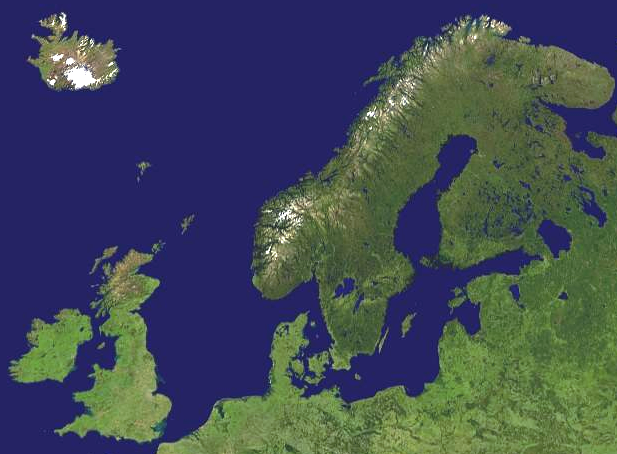
Comparison with neighbours North of 49°N
Denmark (a recap)
- Best use: South-facing façades, canopies, and glazed atria retrofits in urban centres.
- Design priorities: Maintain continuous insulation behind panels (ventilated façade), ensure airtightness, and integrate PV with window placement to balance daylight.
- Benefits: Good winter module efficiency and high urban potential. Lower peak summer generation is not a problem if systems tie into flexible grids and storage.
Netherlands (e.g. Amsterdam, Rotterdam)
- Similarities: Urban density, moderate maritime climate, low roof availability in old districts.
- Differences: Slightly sunnier and somewhat milder winters than Denmark. Flat roofs are more usable in suburbs; façades matter in older city centres.
- Implication: The Netherlands benefits from both rooftop PV and façade BIPV. Integrated façades are valuable in historic centres where rooftop arrays are impractical.
Northern Germany (e.g. Hamburg, Bremen)
- Similarities: Comparable latitude and climate to Denmark. Hamburg’s diffuse winter light mirrors Copenhagen’s.
- Differences: Larger industrial roof stock in some cities means rooftop PV remains important. Building typologies include many brick façades that require sensitive BIPV design for heritage reasons.
- Implication: Where façades are preserved for heritage, lightweight BIPV curtain wall solutions that avoid altering appearance are essential.
Northern France (Lille, Reims, Calais)
- Similarities: Similar diffuse light profile in winter. Urban fabric is mixed.
- Differences: Slightly sunnier overall than Denmark. Heritage constraints are strong in many towns.
- Implication: BIPV is promising but often constrained by conservation rules; discreet integration (solar tiles matching colour/texture) helps.
Finland (e.g. Helsinki)
- Similarities: Cool climate that benefits module efficiency in summer and spring.
- Differences: Farther north, shorter winter photoperiods, more snow and longer periods of low sun. This reduces annual yield from BIPV compared with Denmark. South-facing façades and steep canopies are necessary for winter benefit.
- Implication: BIPV can be part of the mix, but energy planning in Finland will rely more heavily on insulation, heat pumps and district heating. BIPV is a supporting measure rather than a primary generator through winter.
Practical recommendations for Danish practitioners and policy-makers
- Design BIPV as part of the thermal envelope — always keep continuous insulation behind panels. Use ventilated façades or insulated curtain walls.
- Prioritise façades in dense urban projects — vertical surfaces add value in Copenhagen and Aarhus where roofs are often occupied.
- Use bifacial modules selectively — they help where ground or building reflections are significant (snow, light-coloured pavements).
- Match BIPV form to heritage rules — develop solar tiles and coloured modules so old façades can be respected.
- Integrate with heating strategy — BIPV should complement, not replace, high-efficiency insulation and heat pumps.
- Standardise performance metrics — require seasonal yield forecasts (not just peak production) and thermal impact assessments for permitting.
- Run urban pilots — deploy demonstrator façades in Copenhagen, Aarhus, Aalborg and measure real thermal and electrical performance across seasons.
Metrics to demand from suppliers
When assessing BIPV options, require:
- Seasonal yield estimates (monthly output) for the local latitude and orientation.
- U-value and thermal bridging report for the complete wall assembly.
- Moisture and condensation risk assessment for the façade detail.
- Maintenance and cleaning plan specific to vertical installations.
- Lifetime embodied carbon and recyclability statement for the BIPV modules and supporting structure.
Key takeaway
For Denmark, BIPV is not a niche gimmick. It’s a pragmatic way to add renewable capacity in dense cities while improving building envelopes — but only if designers treat the façade as a thermal system and a power system at the same time. When done well, façades become working infrastructure: part of the heating, energy and urban design solution. When done poorly, they are expensive cladding with lost opportunity.
Denmark’s climate, urban form and policy environment give it a clear first-mover advantage. The next steps are practical: pilot projects, clear building rules, and supplier standards that ensure façades generate clean power without costing us thermal comfort.
Source
Rethinking BIPVs – Evaluating the thermal trade-offs of building-integrated photovoltaics, Energy and Buildings, 2025-09-22
 Boˆreal