
The push to expand renewable energy is running into a practical challenge: how to build offshore wind farms quickly and cheaply enough. Offshore wind has huge potential, especially in Northern Europe where countries have access to the sea, but building turbines further out from land comes with steep costs.
A recent study explores an innovative solution: Wind barges offer a fresh approach to designing and installing Floating Offshore Wind Turbines (FOWTs).
Seizing The Opportunity for Floating Offshore Wind
Most offshore wind turbines today are fixed directly into the seabed. That works in shallow waters but quickly becomes expensive and impractical in deep seas. To solve this problem, few examples are better than the sea off Norway, where majestic mountains become famously deep fjords, with deep installation challenges.
Floating Offshore Wind Turbines (FOWTs) are an answer. Instead of being anchored rigidly to the seabed, these turbines float on buoyant structures and are tethered by mooring lines. This opens vast areas of deep water to wind energy development.
But this doesn’t entirely solve the cost challenge: FOWTs are expensive, largely because their floating platforms are complex to design and build.
A New Solution: Wind Barges
The study investigates whether barges — flat, floating structures already common in marine industries — could be adapted as platforms for FOWTs. Compared with specialised floating designs such as semi-submersibles or spar-buoys, barges are simpler and cheaper to construct.
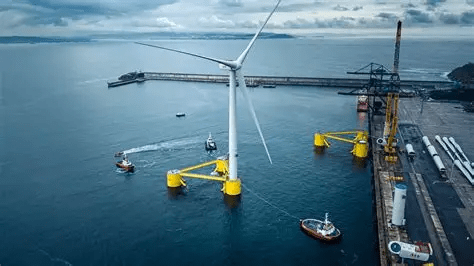
The central question is whether they can perform well enough for offshore wind in Norwegian conditions.
The Research Approach
The study examined:
- Hydrodynamic performance (in the sense of how the barge moves in waves, wind, and currents)
- Mooring system design (how the barge is tethered to the seabed)
- Stability and motion under different offshore conditions
- Cost implications compared with existing floating wind platforms
Advanced simulations were used to test different barge configurations, evaluating how they respond in Norway’s offshore environment.
Key Findings
The results show several important points.
- Wind barges can be stable enough. With the right mooring design, barge-based platforms can remain stable in Norwegian waters, even under harsh wave conditions.
- Motion control is critical. Roll and pitch — the tilting motions of the barge — are the biggest challenges, but better mooring layouts and ballast adjustments help.
- Barges are cheaper and scalable. Their flat construction makes them simpler to manufacture, easier to install, and more straightforward to maintain than complex floating designs.
- Suitable specifically for sheltered seas. Barges aren’t ideal for very rough seas, but could perform well in parts of Norway’s offshore zones with milder conditions.
Why This Matters for the Energy Transition
Extending wind power further offshore is vital for countries such as Norway, where land-based projects face both physical limits and public opposition. If barges can make FOWTs cheaper and faster to deploy, they could accelerate the transition to renewable energy across the global north.
This research suggests that advanced engineering does not always require new and exotic designs — sometimes adapting proven marine technology like barges can provide a practical path forward.
The Bigger Picture
In the race to clean energy, ideas such as erecting turbines floating on wind barges highlight the value of blending innovation with simplicity. They open up the possibility of scaling offshore wind more rapidly, without making the technology prohibitively expensive.
Source
Department of Marine Technology Integrated structural analysis and multiaxial fatigue assessment of a barge-type 15 MW FOWT, Master’s thesis 2025, Fotios Theodorakis, Norwegian University of Science and Technology
 Boˆreal