
For years, solar power has been confined mostly to rooftops, deserts, and fields. But a pioneering study on underwater perovskite solar cells has opened a completely new frontier: generating clean energy beneath the surface. This breakthrough doesn’t just make solar viable in aquatic environments — it reimagines where we might harvest the sun’s power.
The Science Behind Submerged Solar
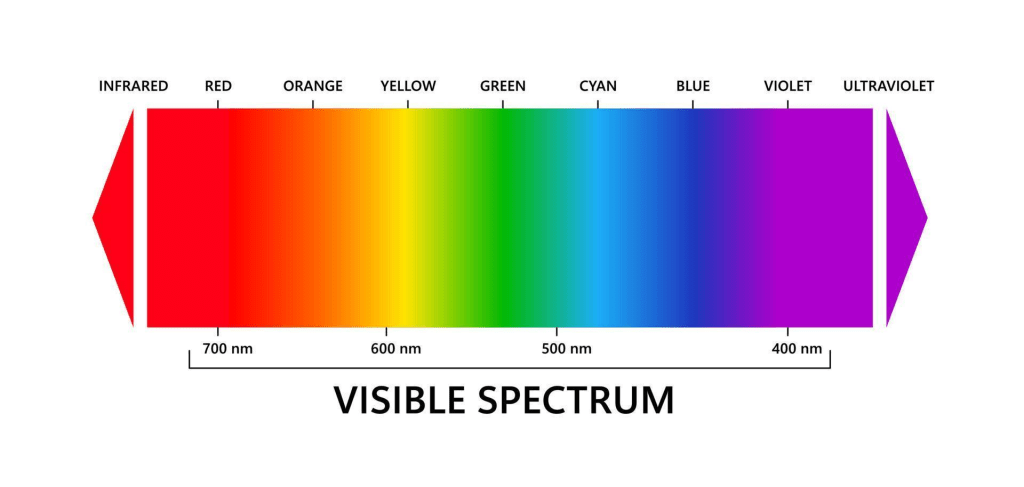
There is great potential for underwater photovoltaics. Why? Because refraction shifts the light to a higher frequency (lower wavelength); towards the blue end of the visible light spectrum:
The study tested perovskite solar cells — known for their high efficiency and tunable properties — encapsulated in protective layers to survive underwater. Remarkably, the researchers discovered that submerging solar cells by just a few centimetres actually boosts their performance. Water acts like an anti-reflective layer, reducing light losses while also cooling the device, both of which improve efficiency.
And with robust encapsulation, the cells resisted corrosion, prevented toxic lead leakage, and remained stable for hundreds of hours in both fresh and salt water.
This is not just about powering small underwater sensors. It opens the door to installing solar cells in places we’ve never considered before.
Where Could We Put Them?
If solar panels can work submerged, our imaginations are the only limit. Here are some possibilities:
🛥 On Boats and Ships
Solar panels could be installed not only on deck but along the sides of hulls, where they could benefit from partial immersion. Maritime industries could use them to power onboard electronics or desalination systems.
🏊 At the Bottom of Swimming Pools
Private homes, hotels, and leisure centres could turn pool floors into energy-harvesting surfaces. Semi-transparent panels could even be integrated for aesthetics, doubling as underwater lighting features.
🐟 In Aquaculture Farms
Fish farms and seaweed cultivation facilities could line their underwater infrastructure with solar panels to power pumps, monitoring systems, and automated feeders.
🏝 Around Floating Resorts or Pontoons
Panels could be placed just below the water surface around floating structures, benefiting from the water’s cooling effect and minimising the visual impact.
🔬 For Scientific Monitoring
From coral reef sensors to deep-sea exploration vehicles, small underwater solar modules could keep instruments running indefinitely without needing battery swaps.
🚢 On Harbour Infrastructure
Ports, docks, and piers could host submerged panels that generate clean power while withstanding saltwater exposure.
A New Kind of Solar Future
The study suggests that near-surface installations could increase efficiency by 5–10% thanks to the refractive properties of water. For deeper applications (like powering underwater Internet-of-Things devices), specially tuned wide-bandgap perovskite cells could still function down to 10 metres in clear water.
And unlike traditional land-based solar, these underwater systems wouldn’t compete for space with agriculture or urban development—they’d make use of otherwise idle aquatic surfaces.
From Rooftops to Oceans
Underwater solar doesn’t replace traditional photovoltaics—it complements them, extending solar power into new domains. The next step will be scaling these laboratory results into real-world pilots: poolside power, energy-generating marinas, and even hybrid floating–submerged solar farms.
The message is clear: the sun’s energy isn’t limited to dry land anymore.
Source
Beneath the Surface: Investigating Perovskite Solar Cells Under Water, Energy & Environmental Materials, 2025-06-27
 Boˆreal