
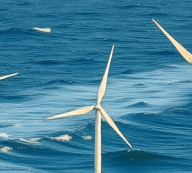
Offshore wind farms are celebrated for their renewable energy contributions, but they also interact with their environments in unexpected ways. A recent study from the Technical University of Denmark, Roskilde, on Zealand [55.7°N, 12.0°E] investigates how wind farms affect surface waves, shedding light on these interactions and their implications for the energy and marine sectors.
Key Findings
- Wave Reduction Behind Wind Farms:
- Offshore wind farms reduce wind speeds at the surface due to wake effects—turbulence caused by turbines slowing down the wind.
- This leads to smaller and less energetic waves in the wake regions, which can extend up to 25 km or more.
- Fetch Effects and Complex Interactions:
- “Fetch” refers to the distance wind travels over water. In areas where wind farms are near the coast, the fetch effect amplifies wind speed and wave growth, counteracting wake-induced reductions.
- Understanding these opposing forces is crucial for predicting wind farm impacts.
- Enhanced Modelling Accuracy:
- By integrating atmospheric and wave models, researchers improved predictions of wave behaviour near wind farms.
- Adjusting parameters to match real-world turbulence effects allowed the models to better reflect observed wave height changes.
Why This Matters
- Marine Ecosystem Impacts:
- Wave energy affects sediment movement, coastal erosion, and marine habitats. Reduced waves in wind farm wakes could have local ecological implications.
- Offshore Operations:
- Smaller waves in wake areas might benefit shipping and maintenance activities, making operations safer and more predictable.
- Renewable Energy Planning:
- Designing future wind farms requires considering not only energy output but also their influence on wind and wave patterns to minimise unintended environmental effects.
A Look Ahead
This research highlights the need for detailed studies on how offshore wind farms interact with their environments. By combining advanced modelling techniques with real-world data, scientists can help optimise the placement and operation of wind farms to balance renewable energy goals with environmental stewardship.
The findings offer a new perspective on offshore wind farms—not just as power generators but as dynamic players in marine ecosystems, underscoring the importance of holistic approaches in sustainable development.
Source
Investigation of wind farm impacts on surface waves using coupled numerical simulations, Renewable Energy, 2024-12
 Boˆreal