
Tidal power is a renewable energy source that utilizes kinetic energy from tidal currents caused by the rise and fall of the ocean tides, which are in turn caused by the gravitational pull of the moon and the sun.
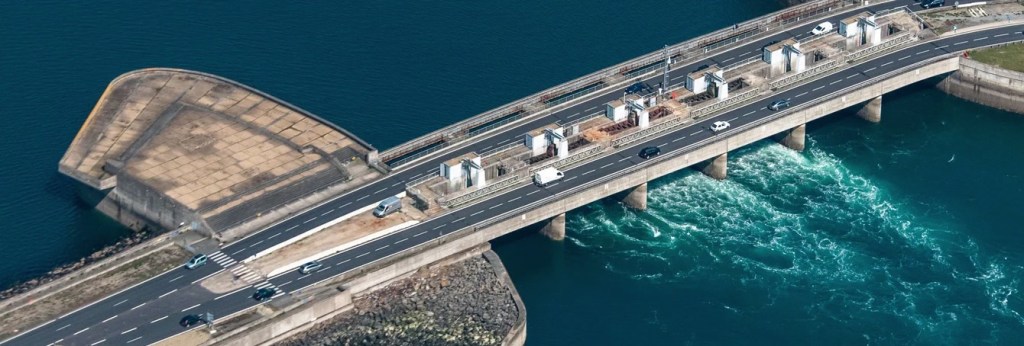
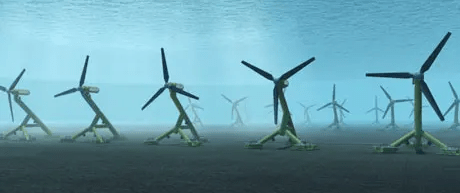
- A common method of tidal power generation is through the use of tidal barrages or turbines. Tidal barrages are long dams built across estuaries or bays, with sluice gates that allow water to flow in and out of the basin during tidal changes.
A different method is to deploy tidal turbines underwater and operate similarly to wind turbines. This is also known as Tidal Stream Energy. - As the tides rise and fall, water flows in and out of the basin or through the tidal turbines, depending on the system used. With a mass of one tonne per cubic metre, the flow of water contains a considerable amount of kinetic energy.
- In tidal barrages, the incoming tide fills the basin, and as the water level rises, it is stored behind the dam. When the tide recedes, the sluice gates are opened, and the stored water is released. The rushing water flows through turbines, driving them to rotate and convert the kinetic energy into mechanical energy.
- The rotating turbines in barrages are connected to electrical generators, which convert the mechanical energy into electricity. Tidal turbines work similarly, with the water flow directly driving the turbines to generate electricity.
- The electricity is then transmitted through cables to the electrical grid, where it can be distributed to consumers. Tidal power plants can provide a consistent and predictable source of electricity, as tides follow a regular pattern.
See also
Ocean Kite Technology for Tidal Energy Generation
How Does Hydroelectric Power (HEP) work?
 Boˆreal